OnTake – online simulated cases

A group of core medical and surgical trainees have developed Ontake – a free online case-based resource – available at www.ontake.co.uk.

Ontake is a library of interactive case-based activities with real-life data from patients that simulate clerking commitments on the wards. The site aims to prepare medical students for work on the surgical or medical admission units. The content is mostly geared towards senior clinical years, although all clinical year medical students will benefit from using the site.

The Ontake cases cover the most common types of medical and general surgical admissions, and the library will continue to grow. The website and cases are free to access.

The content has been reviewed by Dr Andrew Stanton, Senior Medicine and Surgery Lead, and he recommends this for Bristol medics in years 3-5. We hope that you will find the cases useful. Please use the contacts page in the Ontake site to give feedback or ask questions.

image-431

Interdisciplinary Research Projects Opportunity

University Research Committee (URC) / Institute for Advanced Studies (IAS) Undergraduate Interdisciplinary Research Internship Scheme (IRIS)

Undergraduate students are invited to apply to undertake interdisciplinary research projects in summer 2017.

The interdisciplinary research project must be co-supervised by an academic member of staff in the school or department in which the student is registered for their degree (home school or department) and an academic member of staff from another school or department, with a different research background to that of the home supervisor.  Applications for research projects co-supervised by academic members of staff in different faculties are particularly welcomed.

The standard length of the research project will be eight weeks. A poster must be submitted at the end of the project and students must be available to participate in a presentation event in w/c 25 September 2017. NB Students registered for a course with a shorter summer vacation, e.g. medics, may carry out a shorter than eight week research project, and should specify this on the application.

Successful applicants will receive a bursary of £270 per week, based on an hourly rate of £7.70 per hour and a 35 hour working week.  Students are expected to work full time on their research project and so should not carry out other paid work or hold any scholarships in parallel.

For further information on the scheme and application details, see http://www.bristol.ac.uk/ias/urc-funding/research-internships/

The application deadline is Friday, 17 March 2017.

Aungshuk Ghosh Student Prize for Innovative use of e-Learning within Medical Education

Aungshuk Ghosh Student Prize for Innovative use of e-Learning within Medical Education: £300

Submissions for the above are now invited. Details of the prize and nomination forms are located at:

http://bristel.cfme.org.uk/2017-elearning-prize/

This prize is awarded annually.

The selection procedure is a two-stage process.

  1. You need to nominate yourself or a fellow student and complete a short submission form. This should be accompanied by a demonstration of your work/innovation as, and if, appropriate.
  2. We then shortlist the best applications. If shortlisted, you will be invited to present your work to a panel of judges.

Dates to remember:

Deadline for submission forms by email to dominic.alder@bristol.ac.uk: 12noon, Wednesday 8th February 2017.

Presentations by shortlisted students: Great Hall, Friday 24th February 2017 as part of the Student Excellence in Medicine event.

Please contact dominic.alder@bristol.ac.uk with any queries.

Past winners

2016 – Claire Scrivener

image-407

2016 Ghosh Prize Winner: Claire Scrivener

2015 – Simi Ninan
2014 – Chad Pardoe / Niels Leadholm and Richard Purcell
2013 – Finn Catling
2012 – Alona Courtney / Tim Stubbs
2011 – Christopher Smith / Olivia Jagger and Camilla Milner-Smith
2010 – Francesco Egro
2009 – Alastair Buick / Owen Lewis and Haj Kamali
2008 – Helen Taylor
2007 – Will Duffin
2006 – Jocelyn Cherry

Jane Blazeby: Transforming surgical culture

Jane Blazeby, 53, champions better understanding and use of evidence in surgery through randomised controlled trials, a course often advocated but seldom adopted because of methodological challenges and “eminence based” surgical practice. She is professor of surgery at Bristol University and an honorary consultant surgeon focusing on gastrointestinal cancer and emergency care. She directs an MRC hub for trials methodology research and a surgical trials centre, helping surgeons to deliver trials and understand why this is important.

Read the Personal Interview with our Professor of Surgery in this week’s BMJ at BMJ 2017;356:i6463 by following this link: http://www.bmj.com/content/356/bmj.i6463

How long do patients with chronic disease expect to live?

In collaboration with the INSPIRE initiative and Dr Barnaby Hole from the School of Clinical Sciences, 3rd year medic Joseph Salem has recently had a paper published in the BMJ Open titled ‘How long do patients with chronic disease expect to live?’

This is an open-source publication available to read on the BMJ website: http://bmjopen.bmj.com/content/6/12/e012248.full  or download as a PDF by clicking this link:  BMJ Open-2016-Hole-Salem


Bristol Futures

Bristol Futures
While studying at Bristol, our students gain a wide range of knowledge and skills that are not only vital to getting the most out of their time at university, but also in preparing them for whatever comes next.
What is Bristol Futures?
Bristol Futures is being designed with input from academic schools, prospective applicants, current students, and employers to clearly define what makes the ‘Bristol Graduate’ unique. The development of these transferable skills and attributes will be built around three pathways:

  • Innovation & Enterprise
  • Global Citizenship
  • Sustainable Futures

Three optional non-credit-bearing courses aligned with these pathways will be introduced in 2017.
Benefits of Bristol Futures
Bristol Futures will build upon our core academic values and the benefits of a research-led curriculum and encourage our students to be creative, open-minded, confident free thinkers, who make judgements and decisions based on evidence, taking account of the wider context. It will also provide our students with an opportunity to develop their core academic skills further through application outside their own discipline.
How we will implement Bristol Futures
There are multiple aspects to Bristol Futures and implementation will be phased. Working with partners in the city and the wider region, we will coordinate more opportunities for professional and community engagement. These enhanced opportunities will give our students an early insight into careers and help them to develop and apply their skills in a non-academic context. By 2019, all programmes will include elements of the Bristol Futures pathways as part of their credit-bearing curriculum – the way in which these are embedded will vary between disciplines

Information for staff

Further information for staff on Bristol Futures, including how and when it will be implemented.

Information for students

We are including students in the project. Find out about the work they are doing towards Bristol Futures.

Is the Hippocratic Oath still relevant to today’s doctors?

 Is the Hippocratic oath still relevant to practising doctors today? [BMJ]

Authors: Kathy Oxtoby  |  Publication date:  14 Dec 2016  |  Read the full article on the BMJ website

Doctors have so many different views about what professional oaths mean, says Kathy Oxtoby, that it could be time to consider what they should say or if they should take an oath at all.
“I swear by Apollo the Healer, by Asclepius, by Hygieia, by Panacea, and by all the gods and goddesses, making them my witnesses, that I will carry out, according to my ability and judgment, this oath and this indenture.”
This pledge from the Hippocratic oath—written nearly 2500 years ago—forms part of the most famous text in Western medicine. An oath historically taken by physicians, it requires readers to swear by the healing gods that they will uphold specific medical standards.

The Bristol promise

Richard Huxtable, professor of medical ethics and law and director of the Centre for Ethics in Medicine from the school of social and community medicine at Bristol University, describes why Bristol medical students have their own oath:

“The ethics centre was created in 1996 in Bristol, and its first director professor, Alastair Campbell, was approached by medical students who wanted to create, in collaboration with his ethics colleagues, an oath that they could take together on graduation.

“It was very much a staff and student initiative. The “promise” was driven by the need to collectively recognise the values that would guide graduates’ careers.

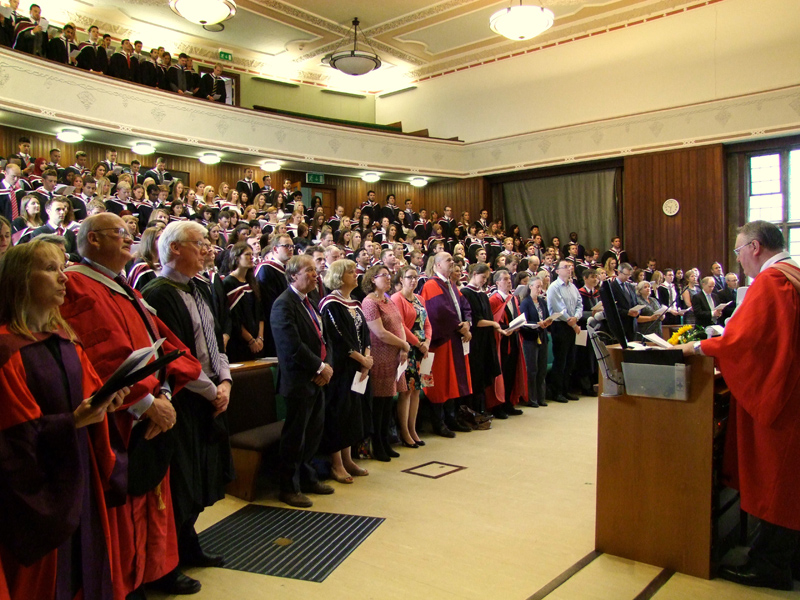
“Twenty years on, the promise remains one of the most powerful moments in the medical school year. Students take the promise at the start of their studies and then again more formally on graduation day, along with staff.

“The values of the promise include: conscience, integrity, confidentiality, and to care for the public’s wellbeing.

“I would invite colleagues to look to what their students want as future professionals when they take an oath. Some may feel their current oath is sufficient, but you should be mindful of changing values and open to the fact that these might change as medical practices evolve.

“At the same time you should acknowledge values that are core to medical endeavour, such as maintaining confidences, avoiding harm, and respecting people’s rights.

“It’s about keeping the essence of the original oath, whilst keeping an eye on future horizons.

Every year we tell students the story of how the promise evolved, to convey how this was not something imposed from on high, but was a collaboration between students and staff.

“I feel privileged to take students through the oath each year.”

Read the full article on the BMJ website

British Geriatrics Society Awards and Prizes

Essay Prizes are available to Medical Students from the British Geriatrics Society.  For more inormation see flyers and website links below: 

BGS AMULREE ESSAY PRIZE 2017 –  Click here for the flyer  for more information and to apply see the website:  http://www.bgs.org.uk/mnutraineefunding-507/resources/grantsawards/amulreeessay

BGS Movement Disorder Prize 2017 – Click here for the flyer for more information and to apply see the website: http://www.bgs.org.uk/mnutraineefunding-507/resources/grantsawards/movementdisordersaward

BGS Bullpitt Scholarship Prize 2017 – Click here for the flyer for more information and to apply see the website: http://www.bgs.org.uk/mnutraineefunding-507/resources/grantsawards/bgs-cardio-bulpitt-undergrad-award